

Views: 0 Author: Site Editor Publish Time: 2026-10-16 Origin: Site


Custom perfume boxes cost varies widely. Basic styles often cost under $1.00 per unit, while premium specs reach $4–$5 per box. Materials, design and printing, finishing and tooling, order quantity, compliance, and logistics drive that spread.
Your real question goes beyond price. You want to know what you pay for and where you can save without hurting shelf appeal. Custom perfume packaging also works as a branding tool, so design investment matters.
This guide breaks down each factor with practical tips. You can then read a custom perfume box quote line by line, compare suppliers, and budget with confidence. Smart perfume packaging choices start with clear numbers.
The material you pick sets the starting price: folding cartons cost less than rigid boxes.
Design complexity and printing method change your total cost a lot.
Order quantity lowers the price per unit: buying more reduces setup and tooling costs.
Compliance and logistics add costs you might not see: plan for labeling, safety, and freight.
Smart choices balance quality and budget: match your packaging to your brand and how much you order.
Material choice is your first price lever. It sets the floor for every other decision. Match the material to your brand style, your product's price point, and your shipping needs. Material selection usually comes first, and box structure follows. A heavy glass flacon needs a stronger board. A light sampler may travel in a folding carton.
Folding paperboard cartons and rigid boxes serve different tiers. Paperboard suits lighter products and tighter budgets. Rigid boxes signal luxury and protect heavy glass bottles. Neither option wins in every case. Each fits a specific job. Paperboard ships flat and saves freight space. Rigid boxes arrive assembled and ready to fill.
Many brands start with custom perfume boxes for a launch. A custom perfume packaging program pairs the box with secondary packaging such as a sleeve or shipper. If you compare perfume packaging boxes across suppliers, ask for itemized quotes. A simple perfume box may run cheaper than a perfume packaging box with inserts. Look for lower-cost packaging options when volume is tight. Rigid boxes cost more upfront but protect glass in transit.
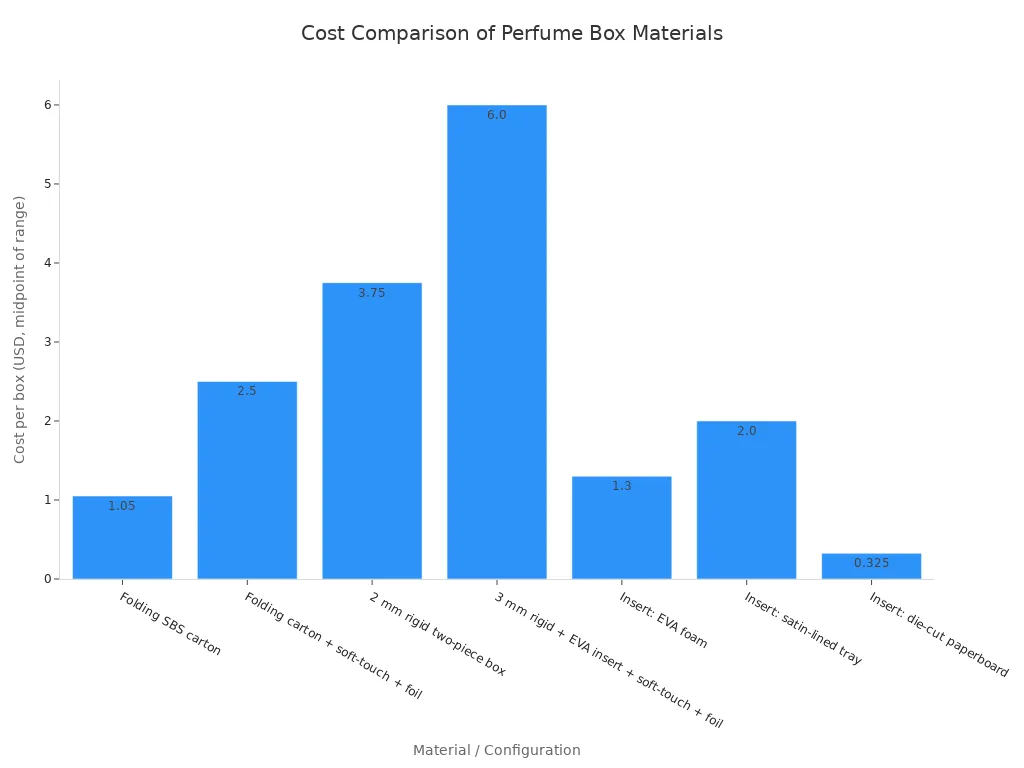
The table below shows typical per-box prices for a 500-unit run.
Material / Configuration | Cost per box (500-unit run) |
|---|---|
Folding SBS carton (24–28 pt, 1-color/CMYK) | $0.60–$1.50 |
Folding carton + soft-touch + foil accent | $1.50–$3.50 |
2 mm rigid two-piece box | $2.50–$5.00 |
3 mm rigid + EVA insert + soft-touch + foil | $4.00–$8.00 |
Insert adders: EVA foam | +$0.60–$2.00 |
Insert adders: satin-lined tray | +$1.00–$3.00 |
Insert adders: die-cut paperboard | +$0.15–$0.50 |
A folding carton is the cheapest structure. A 3 mm rigid box runs 5–10x more expensive. Per-box cost drops 30–40% when you move from 500 to 5,000 units.
Eco-friendly perfume packaging materials carry a premium. Green shipping boxes run about $2.00 per unit versus $0.40 for standard boxes — roughly 5x higher. Overall production expenses run 20%–30% higher.
Packaging Material | Eco-Friendly Cost | Standard Cost | Premium |
|---|---|---|---|
Green shipping boxes | $2.00 per unit | $0.40 per unit | ~$1.60 more per unit (5x higher) |
Overall production costs | — | — | 20%–30% higher |
These options fit brands that lead with sustainability. They work well for premium launches where the story justifies the spend. Standard materials remain a sound choice for volume-driven lines. Rigid boxes and paperboard both offer eco versions. Compare perfume packaging materials carefully. Recycled perfume packaging materials may suit your brand. Test perfume packaging materials before you commit.
Design complexity drives cost. Stock artwork costs little because the supplier already owns the files. A fully custom design adds design hours, proof rounds, and prepress work. Treat this spend as a branding investment. Your perfume packaging carries the brand story on the shelf. A distinctive design earns attention and supports a higher retail price. Simple artwork on standard templates keeps pricing low for launch volumes. You can also order custom perfume boxes with a stock structure and custom graphics. That mix controls cost while keeping the look unique.
The printing method you pick changes how your costs work. Offset printing has a higher setup cost, mostly for making plates, but the per-unit cost drops at scale. Digital printing skips setup costs and works well for small batches. You print only what you need, so you avoid overproduction and inventory costs.
Order Quantity | Recommended Printing Method | Cost Rationale |
|---|---|---|
Under 2,000 pieces | Digital printing | No setup costs; cost-effective for small batches |
2,000–5,000 pieces | Either (decide by complexity, finishing, delivery) | Trade-off zone between setup cost and per-unit cost |
Over 5,000 pieces | Offset printing | Higher setup cost spread over volume yields lower per-unit cost |
Perfume box dimensions also change the cost. Bigger or odd sizes use more paper and more insert material. A 100ml bottle with a large cap needs a bigger cavity than a compact 50ml bottle. Even a 10mm increase in box width changes freight efficiency when 1,000 rigid boxes pack into export cartons. Non-standard sizes may need a custom die line. Finalize dimensions early, because they drive die lines, material use, and shipping cube.
Fixed setup costs and labor have a much bigger impact at low order quantities (500 pieces) than paper cost alone. For a custom perfume box, the supplier may need a custom die line, print setup, foil plate, and manual QC standard for bottle fit — and even when material cost changes by only a few cents, these non-material (tooling) costs stay nearly the same whether you order 500 or 1,000 units.
Decorative finishes add cost because each one adds a step in production. Foil stamping, embossing, debossing, spot UV, and soft-touch all raise the price per unit. Each finish does a different job. Foil works well for a metallic logo on a dark background. Embossing gives a raised logo without ink. A die-cut window shows the bottle and adds a die cost. Pick one or two finishes that show off your brand mark. Piling many finishes on one perfume packaging box multiplies setup work and slows production.
Tooling is a one-time cost, and it gets spread across your order. A box dieline and print setup usually costs $80–$200. At 500 units, that adds $0.16–$0.40 per box. At 5,000 units, the same setup adds only $0.02–$0.04. A new mold usually needs an MOQ of 3,000–5,000 pieces before the per-piece tooling cost makes sense. Below about 3,000 pieces, tooling pushes unit cost up sharply.
Inserts protect the bottle and shape the unboxing moment. Your options come at different cost levels:
EVA foam: firm, exact cavities for heavy or angular bottles; costs more than simple cardboard.
Sponge foam (PU/EPE): soft cushioning at a good value; lighter shipping weight.
Paperboard tray: recyclable and cost-efficient for mass-market launches.
Molded pulp: recycled fiber for eco-luxury positioning.
Fabric-wrapped inserts: a premium interior feel at higher cost and more assembly control.
Large or heavy glass bottles need stronger board and accurate sizing, so inserts become essential. One supplier lists a 100-box minimum and about 12–15 business days after approval. Confirm insert materials and volume in your quote, since these choices drive both cost and lead time.
Order quantity is one of the biggest cost drivers in any custom perfume boxes cost estimate. Unit price drops as volume goes up, because setup work, tooling, and machine time spread across more units. A short run of 100–300 units carries a high per-unit cost. Folding cartons become cost-effective from 500 units. Rigid boxes usually need 300–500 units minimum for a fully custom build. Factory-direct rates typically start at 1,000-unit runs. Review custom perfume boxes cost at each tier before you commit.
The price break is easy to see in a real tier. Ask for tiered rates at 500, 1,000, and 5,000 units so you can plan reorders. Compare custom perfume boxes across suppliers at the same volume. A supplier that quotes one flat rate hides where your money goes. Volume also changes how you buy board. A 5,000-unit run lets a printer order in bulk and cut waste. A 100-unit run pays higher board prices. That gap shows up in the per-box rate. Request the tier table in writing so you can model your budget at each volume.
Minimum order quantities vary by box format. Standard folding cartons often start at 50 units. Specialty rigid presentation boxes commonly require 100 units. Trial runs under 50 units are available by quote, subject to structure feasibility. Some suppliers advertise low minimums for small and indie fragrance brands. One states a lowest MOQ of only 50 units and a special discount on bulk orders.
"We provide lowest MOQ of only 50 units and a special discount on bulk orders."
Small batches suit launch volumes and test markets. Expect a higher per-unit cost than a standard MOQ run. Digital printing and short-run offset printing make these runs accessible. Confirm the MOQ against your launch forecast before you commit. A 50-unit trial lets you test fit and finish with real bottles. You then scale to a larger run once the design proves out. Small runs also limit finishing options, since foil plates and dies cost the same at any volume. Ask for the MOQ in writing, because one supplier may list 100 boxes in an FAQ and 50 units elsewhere.
Wholesale suppliers may offer discounts of up to 20% and free instant quotes. Request an itemized custom quote that separates materials, printing, finishing, tooling, and freight. Compare perfume packaging wholesale offers on the same basis. A clear quote lets you spot where custom perfume packaging wholesale rates differ. Use it to negotiate better perfume packaging wholesale terms. Ask how each supplier sources materials for rigid and folding formats. Confirm which materials suit your bottle weight. Compare materials across two or three suppliers. Material prices fluctuate, so confirm that your materials quote holds for a set period. Check how secondary packaging and inserts change the total. A perfume box quote should list the MOQ for each format you consider. Every perfume packaging decision should rest on real numbers, not a single lump sum. Strong perfume packaging starts with a quote you can read line by line.
Rules and regulations add real cost to your perfume packaging budget. Each market has its own labeling and safety rules. You pay for artwork updates, compliance review, and testing at approved facilities. Plan for these costs from the start.
Region | Authority / Standard | Labeling & Safety Requirement |
|---|---|---|
EU | REACH | Chemical compounds (incl. essential oils) must be registered, evaluated, and authorized before entering/production in EU |
EU | CLP Regulation (EC) No. 1272/2008 | Naming/labelling aligned with GHS; specific instructions and hazard pictograms required; self-classification by manufacturers/importers |
EU | IFRA / RIFM | Risk assessment of fragrance chemicals; usage recommendations; prohibited/restricted ingredient lists |
US | FDA (MoCRA 2023) | Perfumes classified as cosmetics; FDA to issue fragrance allergen list; labeling regulated by FDA, advertising by FTC; no pre-market approval required |
US | FDA labeling rules (21 CFR 701) | Ingredient declaration in descending order, minimum letter heights, English language, conspicuous placement; warnings for hazardous products; tamper-resistant packaging for certain products |
Australia | NICNAS / AICS | Substances must be registered on Australian Inventory or undergo NICNAS assessment; label must state "fragrance" or "perfume" but need not specify components |
KSA | SFDA | Adheres to GCC/EU standards; labels must include ethanol percentage and Arabic usage instructions |
UAE | ESMA / ECAS | Must comply with IFRA; labels must meet specific standards and mention IFRA conformity |
Canada | Health Canada | Fragrance ingredients scrutinized; hazardous scent components prohibited; Cosmetic Ingredient Hotlist applies |
India | Government of India | Must disclose 26 fragrance allergens when exceeding 0.01% (rinse-off) or 0.001% (leave-on) |
Manufacturers of scents and perfumes must adhere to IFRA regulations on banned, restricted, or specified substances. Suppliers are obligated to conduct quality assurance and safety testing on all items at approved facilities and provide supporting documentation to ensure regulatory compliance.
US rules show how much detail you must plan for. Ingredient lists must be easy to see and read at purchase, with letters at least 1/16 inch tall (1/32 inch if the label is under 12 sq in). Ingredients go in order from most to least. Required statements must be in English and placed where people will notice them. The FDA does not require safety testing, but it strongly urges toxicological testing. If safety is not proven, you may need the warning "The safety of this product has not been determined."
Balance good looks, a strong structure, and following the rules. A beautiful perfume box fails if the label misses a required statement. Check your artwork against each target market before you print.
Freight and storage change your landed cost per unit. Standard delivery finishes in under 10 days. Orders ship within 4–6 business days under international standard shipment policies. You can ask for expedited shipping. Some suppliers offer free shipping to the USA, UK, Canada, and Australia, with order tracking included. Flat-packed delivery saves space, and palletizing helps with large bulk orders.
Watch for hidden costs in any quote. One supplier states "no hidden charges on any order" and "what you see in your quote is exactly what you pay, nothing more." Free design is included, and price varies only by material, box style, sample slots, and quantity. Ask every supplier for a custom quote that separates freight, duties, and storage. Confirm whether secondary packaging ships flat or assembled. Request a custom perfume packaging wholesale comparison on the same terms. A clear perfume packaging wholesale offer lets you spot the true costs. Review your perfume boxes quote for warehousing fees before you sign. Compare perfume packaging wholesale terms across suppliers. A transparent perfume box quote protects your margin.
Custom perfume boxes cost depends on six main things: materials, design and printing, finishing and tooling, order quantity, compliance, and logistics. Basic folding cartons cost about $1.00 per unit, and premium rigid boxes reach $4–$5. That range lets you match your spending to how high-end you want the shelf look to be.
Use this checklist to keep custom perfume packaging efficient:
Match the packaging tier to your product's price point.
Confirm the MOQ against your launch volume.
Ask for itemized quotes that cover material, printing, finishing, tooling, and freight.
Test samples of perfume boxes before you commit.
You now have a clear picture of what drives cost in perfume packaging. Smart buyers balance quality and budget by matching each factor to brand priorities. Review your perfume packaging plan, compare perfume packaging quotes, and confirm secondary packaging needs. Good perfume packaging decisions start with numbers you can defend.
Most projects cost between about $1.00 and $4–$5 per box. Basic folding cartons are near the low end. Premium rigid builds with inserts and foil reach the top. Your material, print method, finish, and order volume set the final price.
Start with a stock structure and custom graphics. Choose digital printing for small runs. Limit yourself to one or two finishes. Raise your order quantity when your forecast allows it. These moves cut cost while your perfume packaging still looks premium on the shelf.
No. Standard folding cartons often start at 50 units, and specialty rigid boxes commonly require 100 units. Small batches cost more per unit. Test fit and finish at low volume, then scale up once your design proves out.
Ask for separate lines for material, printing, finishing, tooling, and freight. Confirm the MOQ for each format. Check whether setup fees are one-time. A clear quote lets you compare suppliers on equal terms and spot hidden charges before you sign.
Standard delivery finishes in under 10 days. Orders ship within 4–6 business days under international standard shipment policies. Expedited options exist. Confirm lead times in writing, since inserts and complex finishing add production steps to your perfume boxes order.


