

Views: 0 Author: Site Editor Publish Time: 2026-10-23 Origin: Site


You determine right box size by measuring the perfume bottle's height, width, and depth, then adding clearance for inserts and labels. This guide gives typical dimensions for 30ml, 50ml, and 100ml bottles. It also shows you how to measure a bottle and test the fit before you order. Capacity alone will not tell you the right perfume box size. A tall 30ml bottle can need a larger box than a short 50ml one. Measure first, then choose. The steps below help you find a size that protects the bottle and presents it well. You can apply the same method to every 100ml, 50ml, and 30ml bottle in your line.
Measure your perfume bottle with the cap on to get the true height, width, and depth.
Add extra space for inserts and labels so the bottle fits securely inside the box.
Test a paper mock-up of your box before you order to confirm the bottle fits well.
Check shipping and labeling rules for your market because they can change the box size you need.
Choose a box style that matches your protection needs and budget for each bottle size.
Most 30ml perfume boxes have inside measurements of about 35–45 × 35–45 × 90–120 mm. Use this as a starting point, not a promise. The final size depends on the bottle shape and the cap height.
Item | Reference Value | Notes |
|---|---|---|
Typical internal box dimensions (30ml) | 35–45 × 35–45 × 90–120 mm | Changes with bottle shape and cap height |
Slim bottle boxes | Taller and narrower | Fits a long, thin bottle shape |
Short square bottle boxes | More width and depth | Fits a wider bottle shape |
Rigid box clearance | ~2–3 mm around bottle | Add more for heavy, odd-shaped, or delicate bottles |
Paperboard carton clearance | ~1–2 mm per side | Raise to 2–3 mm for tall, heavy, or odd-shaped bottles |
Height driver | Cap and sprayer | Can change final height more than the glass body |
A slim 30ml perfume bottle makes the box taller and narrower. A short square bottle needs more width and depth instead. The cap and sprayer often set the final height more than the glass body does. Check the bottle with the cap on before you lock in dimensions for your 30ml perfume boxes.
A 100ml bottle needs a bigger, stronger outer carton than a 30ml bottle. The extra glass weight and liquid volume call for thicker board and more support inside. Typical 50ml perfume boxes are larger than 30ml boxes in every direction, and 100ml perfume boxes are larger still. Measure each bottle instead of guessing by scaling up a smaller box.
Ounce labels cause confusion here. One US fluid ounce equals 29.5735 ml, so 1.7 oz is about 50ml and 3.4 oz is about 100ml. The imperial fluid ounce equals 28.4131 ml, a gap of about four percent. Cosmetic labels in the UK and EU use milliliters, so the imperial ounce rarely shows up on fragrance packaging. When a US customer quotes ounces, assume the US value unless told otherwise.
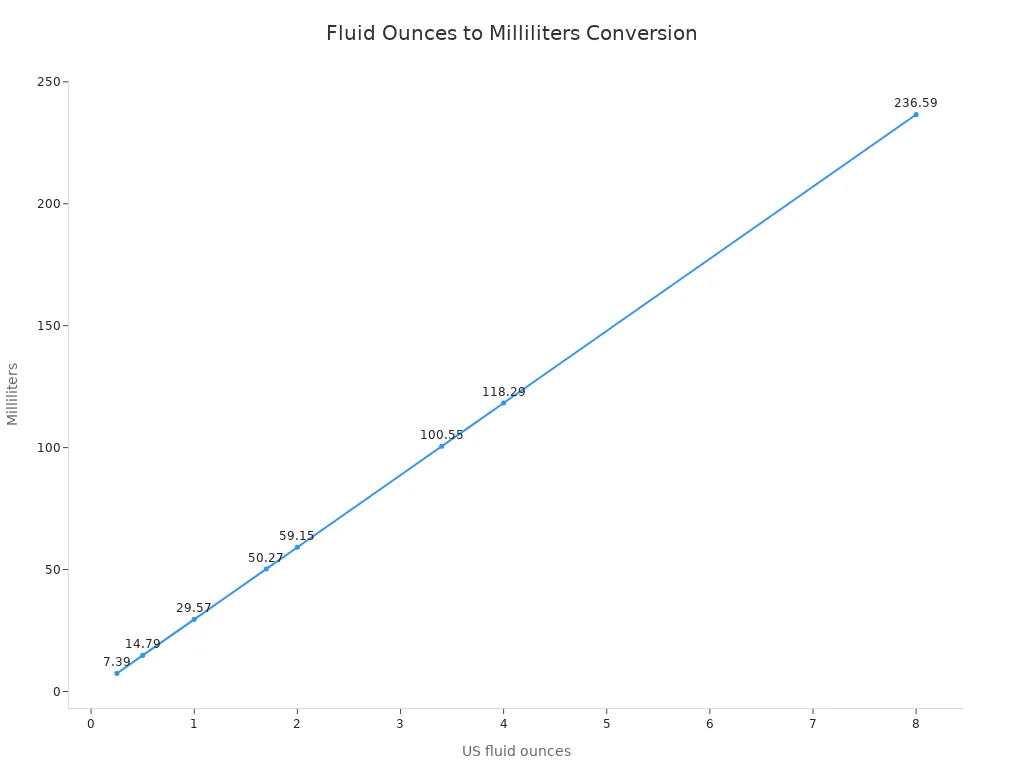
The standard industry conversion for perfume bottle sizes is 1 fl oz ≈ 29.57 ml, which brands usually round to 30 ml for clean product labels. That rounding explains why the 30ml, 50ml, and 100ml bottles you see on shelves line up so neatly with 1 oz, 1.7 oz, and 3.4 oz.
Picking a box by volume alone can lead to a bad fit. A tall, narrow 50ml perfume bottle may need a box as tall as one made for a squat 100ml perfume bottle. The 50ml vs 100ml perfume comparison falls apart fast when you ignore shape. Actual bottle dimensions, not capacity, drive box size. Confirm the right perfume box size by measuring the real bottle, then match your perfume box dimensions to that measurement.
Measure the perfume bottle with the cap and sprayer on. The cap often adds more height than the glass body. So a measurement taken without it will show a smaller size than the real one. Follow these steps in order:
Stand the capped bottle upright on a flat surface. Put a ruler or caliper beside it. Measure from the base to the highest point of the cap. Write this down as the height.
Turn the bottle a quarter turn. Measure across the widest point of the body. Write this down as the width.
Turn it another quarter turn. Measure the remaining side-to-side span. Write this down as the depth.
Take each reading twice. If the two readings are different, use the larger value.
You measure the height first because it usually sets the tallest part of the box. Then check width and depth on the same bottle. A tapered or curved body can be wider at the shoulder than at the base. Always include the cap and sprayer in every reading.
Write each reading down with its unit, and use one unit the whole time. Mixing inches and millimeters is a common cause of costly errors. Note how the bottle sits too. A bottle that stands tall upright may run long when laid on its side.
Turn your bottle measurements into a starting box size by adding clearance to each number. The result gives you the width, depth, and height you need for the inside of the carton. Record perfume box dimensions as inside measurements, never outside ones. Measuring the outside of a box gives you a carton too small for the product.
Several mistakes can ruin a careful measurement:
Trusting supplier-listed numbers instead of measuring the real bottle yourself.
Forgetting the insert, which leaves the bottle loose inside the box.
Ignoring the empty space needed to cushion fragile products.
Mixing up length and width on bases that are not square.
Skipping product tolerance, the normal size variation during manufacturing, so some units fit too tight or too loose.
Picking a box that is too big, which raises packing and dimensional-weight shipping costs.
Each error is cheap to fix on paper and expensive to fix after printing. Accurate dimensions taken from the real bottle remove most of the risk. Use them to determine right box size before you commit to a production run. The same method works whether you pack a 30ml, 50ml, or 100ml perfume bottle. A 50ml perfume bottle and a 100ml perfume bottle rarely share a carton, and only measurement confirms the difference. Skipping a physical sample before full production lets size issues show up after printing, when fixing them costs the most. Take the readings, add clearance, and confirm the right perfume box size with a test fit.
Clearance is the extra empty space you add to a box beyond the bottle's measured size. An insert is the inside part that holds the bottle in place, like a platform, foam block, or molded pulp cradle. Both of these change the inside size you need. You cannot finalize your perfume box dimensions until you count for them.
Each insert type takes up a different amount of room. A flat platform lifts the bottle off the box floor and adds height. Foam blocks protect the bottle on all sides and add space in every direction. Molded pulp cradles wrap around the bottle shape and add a moderate allowance around the body. Plan the insert before you set the box size, because the insert sits between the glass and the carton wall.
Pay special attention to the neck and cap. Clearance around the neck and cap keeps the fit proper without pressure or looseness. An atomizer clearance void stops the cap and sprayer from touching the box interior. Isolate the atomizer inside that void so nothing touches it from any direction. Check atomizer clearance before you commit to a volume, whether you pack a 30ml, 50ml, or 100ml perfume bottle. Every perfume bottle in your line deserves this check.
Labels and wraps add thickness to the outside of the box. A wrap covers the full carton and adds a small but real amount to the overall dimensions. A label adds thickness on one or two faces only. Account for these layers when you confirm the right perfume box size, or the finished box will fit tighter than planned.
The lid or flap clearance deserves a check too. Verify it alongside bottle height, width, diameter, and shoulder profile so the packaging closes without too much pressure or looseness. Record every allowance with your box dimensions, then test the full assembly. Confirm these dimensions against the real bottle. A careful size check now saves a reprint later.
Make a paper model before you pay for a full production run. Cut a piece of card stock to the planned flat template. Fold it on the planned crease lines and tape the corners. You now have a cheap model of your final box dimensions.
Put the perfume bottle inside with the insert in place. Close the lid and shake the model gently. The bottle should not move. Check three things: the cap clears the top panel, the insert holds the body steady, and the flaps close without force. Do this test for your 30ml, 50ml, and 100ml sizes, because each one fits differently.
Check the shipping and labeling rules for your market before you lock the size. Perfume with alcohol often counts as a flammable liquid. In the United States, the Department of Transportation and its Hazardous Materials Regulations define when a liquid perfume is regulated as a hazardous material. Fragrances with high alcohol usually fall under Class 3, which triggers packaging, labeling, and documentation duties.
Air transport follows IATA rules, which are stricter than ground rules. Many perfumes allowed by ground are limited or banned by aircraft.
Sea transport follows the IMDG code, with its own packaging and documentation requirements.
USPS does not allow international shipping of alcohol-based perfume. Such packages are likely to be stopped and returned.
EU imports must carry fragrance allergen labeling under EU Cosmetics Regulation (EC) No 1223/2009 before import.
US cosmetic labels must also meet 21 CFR parts 701 and 740:
Label Area | Required Element | Regulatory Basis |
|---|---|---|
Main Display Panel | Declaration of identity and net content | 21 CFR 701.11, 701.13 |
Information Panel | Company name and location; distributor statement | 21 CFR 701.12 |
Information Panel | Warning statements, emphasizing flammability | 21 CFR 740.1 |
Information Panel | Components in descending order of proportion | 21 CFR 701 |
Leaving required hazmat labels off the outer box is a common compliance failure. For international air shipments, complete a Shipper's Declaration for Dangerous Goods. These rules can change your perfume box dimensions, so check them before you determine right box size.
Each box style uses up inside space in its own way. A tuck-end carton folds flat and uses thin board, so it adds little to your measured dimensions. A two-piece box has a lid that overlaps the base, and that overlap takes away from the usable height. A rigid box uses thicker walls, so the outside grows while the inside stays close to your bottle measurements. Plan the style first, then set the inside dimensions around it.
The style also changes how the bottle sits. A drawer box needs a sliding tray, and the tray walls take space on every side. A hinged lid box leaves the whole base open, which works well for a taller perfume bottle with a wide cap. Compare your 30ml, 50ml, and 100ml options against the style you want. A 100ml perfume bottle in a rigid shell needs more room than the same bottle in a folding carton.
Style affects protection, cost, and presentation all at once. Use this comparison to see where each option fits best.
Box Style | Protection | Cost / Positioning | Presentation |
|---|---|---|---|
Magnetic Closure Box | High | Premium / small luxury batches | Smooth magnetic flap, modern look |
Double Door Magnetic Box | High | Highest luxury tier | Theatrical center-opening reveal |
Hinged Lid Box | Highest | Premium / classic lines | Book-style lid, traditional elegance |
Lift-Off Lid Box | High | Mid-range, elegant yet affordable | Clean minimalist silhouette |
Drawer (Slide) Box | Highest | Highest luxury tier | Interactive sliding unboxing |
Folding Box | Moderate | Lowest cost, scalable for mass retail | Lightweight, cost-efficient |
Mailer Box | Good | Low cost, e-commerce friendly | Protective self-closing flaps |
Glass bottles need strong structural support. Rigid magnetic and hinged styles give the strongest protection, while mailer and folding boxes stay cost-efficient and safe in transit for e-commerce. Small luxury batches suit magnetic, drawer, or hinged boxes. Large-scale production favors folding or mailer boxes to keep costs low. Mid-range collections balance elegance and affordability with lift-off boxes. Many brands mix styles: luxury boxes for premium lines, folding or mailer boxes for volume products. Match the style to your channel, then confirm the right perfume box size for each line.
You now have a clear method to determine right box size. Measure the perfume bottle with the cap on, add clearance for inserts and labels, then test the fit before you order. This approach works for 30ml, 50ml, and 100ml bottles alike.
Confirm shipping and labeling rules for your market before you finalize the right perfume box size. Hazmat and allergen rules can shift your dimensions.
Order samples for each of your 30ml, 50ml, and 100ml perfume bottle sizes. Check every perfume bottle by hand. A quick sample test confirms the size works for your 30ml, 50ml, and 100ml lineup. Trust the measurements, and your perfume packaging will fit right the first time.
Measure the capped bottle first. Add clearance for the insert and any label or wrap. Then build a paper mock-up and test the fit. Capacity alone will not guide you, because bottle shape drives the final dimensions.
Match the gift to the occasion. A smaller bottle suits a light introduction, while a larger one gives more wear. Consider the recipient's habits and the presentation you want. The box style matters as much as the volume inside.
Wear frequency sets the answer. A daily user finishes a small bottle faster than an occasional one. Store the bottle away from heat and light to protect the scent. Track your own use to judge timing.
No. A 30ml, 50ml, and 100ml perfume bottle rarely share one carton. Each perfume bottle has its own height, width, and depth. Measure each one and confirm the size with a sample before you order.
Yes. A box that is too large raises dimensional-weight costs. A box that is too small risks damage to the perfume bottle. Confirm hazmat and labeling rules for your market, then match the size to both protection and shipping needs.


