

Views: 0 Author: Site Editor Publish Time: 2026-11-04 Origin: Site


Foundation packaging boxes for heavy glass bottles must balance presentation with practical protection. A box may look suitable on a retail shelf but still allow the bottle to move, press against its pump, or damage the packaging during delivery.
For beauty brands, the best starting point is the complete packaging system: the bottle and closure, the retail box, the internal support, and the outer shipping configuration.
This guide explains how to specify that system, compare structures and inserts, and validate the design before ordering in bulk.
Table of Contents
Use the actual production bottle with its pump, cap, collar, label, and any tamper-evident components fitted.
Record:
Maximum height, width, and depth or diameter.
Filled weight, including the closure.
Bottle shape and dimensional variation.
Projections such as a pump nozzle or decorative collar.
Areas vulnerable to scuffing or label damage.
Required packing orientation.
A capacity description such as “30 ml” is not enough to size a box. Bottles with the same nominal capacity can have different external dimensions and weights.
Confirm whether the bottle supplier may change the mold, closure, or label construction. These changes can affect insert fit and packaging performance.
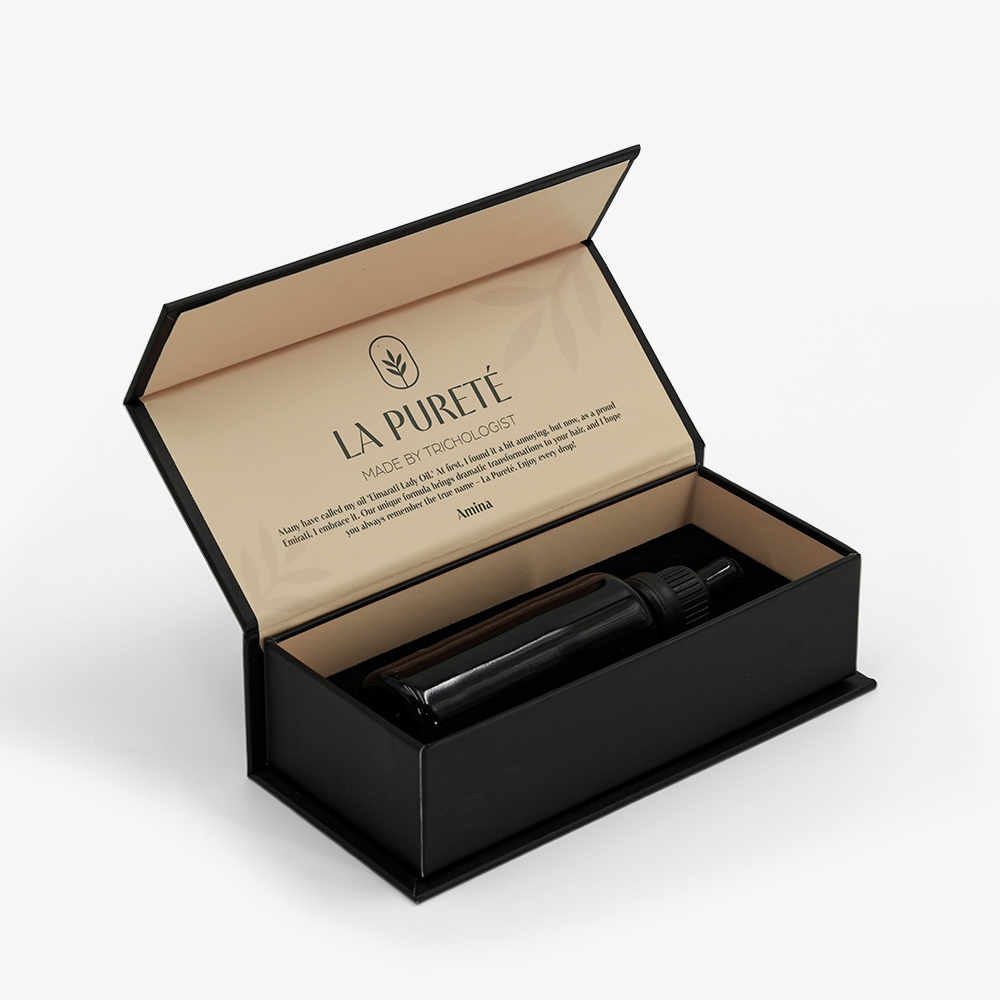
A folding carton usually provides branding, product information, and basic containment. A rigid box can provide a more substantial presentation and support a fitted insert.
Neither structure should automatically be treated as a standalone parcel shipper.
Packaging layer | Main function | What to verify |
|---|---|---|
Bottle and closure | Contain the foundation | Compatibility, closure integrity, and unintended pump activation |
Retail box | Present and identify the product | Dimensions, bottom construction, opening, and appearance |
Insert | Locate and support the bottle | Retention, contact points, clearance, and assembly |
Shipping carton or mailer | Protect the packed product through distribution | Cushioning, compression, closure, and transport performance |
Define whether the product travels in wholesale master cartons, individually through parcel delivery, or as part of a gift set. Each route can require a different outer configuration.
Yison’s cosmetic packaging range provides structures to review against your bottle and sales channel.
A folding carton can be appropriate when the design provides adequate support and the shipping configuration supplies the necessary transport protection.
For heavier bottles, check the bottom closure, insert support, board specification, and assembled dimensions. Board thickness alone does not establish performance.
Evaluate whether the bottle load is properly supported or concentrated on a weak flap or small contact area. Also check that the carton stays closed during handling and that packing staff can assemble it consistently.
Rigid boxes may suit premium launches, gift sets, or products requiring a more structured opening experience.
However, a rigid outer shell does not automatically cushion a glass bottle. The insert and shipping pack still need evaluation.
Compare the additional material, assembled shipping volume, packing time, and removal experience. A bottle should remain controlled during handling while still being accessible to the customer.
Corrugated packaging may serve as an outer shipper, mailer, or combined presentation-and-shipping structure.
Select the construction using packed weight, dimensions, stacking conditions, humidity, and the intended distribution route.
There is no universal weight capacity for every single-wall or double-wall box. Double-wall construction does not simply provide twice the protection. Paper properties, flute configuration, box geometry, closure, and manufacturing quality all contribute.
Yison’s corrugated gift box for skincare sets illustrates a related packaging format. Its suitability for a particular foundation bottle must be assessed using the complete packed product.

Insert option | Potential use | Points to check |
|---|---|---|
Folded paperboard | Structured retention in a compact carton | Tabs, support geometry, assembly, and repeated handling |
Corrugated insert | Support and separation within a larger pack | Fold accuracy, edge contact, and cushioning behavior |
Molded pulp | Shaped support around the product | Dimensional consistency, surface contact, and moisture response |
Foam insert | Shaped retention and cushioning | Material properties, fit, compression, and disposal route |
No insert material guarantees protection by name alone.
The design should support suitable areas of the bottle, restrain movement, and leave clearance around vulnerable features. Avoid making the pump, nozzle, or decorative cap the main path for carrying impact or compression loads.
Loose fill can supplement some shipping designs, but it should not replace a defined retention system where a heavy bottle can migrate through the material.
A bottle needs enough clearance for manufacturing variation and packing. Excessive clearance can allow repeated impacts; an overly tight cavity can cause assembly difficulties, abrasion, or pressure on vulnerable components.
Use physical samples to check both the box’s internal dimensions and the insert cavity. External box dimensions do not establish usable internal space.
For a range of shades using the same bottle, confirm that labels or decoration do not alter the fit. If several bottle designs share one box, validate each configuration.
Foundation gift sets may include a brush, sponge, primer, or another glass bottle. Each item should have a defined position.
Check that accessories cannot strike the glass, rub printed surfaces, or press the pump during handling. Partitions prevent contact only when their height, strength, and attachment suit the packed contents.
A divider can separate products without providing sufficient impact cushioning. Evaluate both functions.
A paper box or insert cannot compensate for an unsuitable bottle closure.
Verify closure assembly, pump-lock operation, and product compatibility with the bottle supplier. Assess the filled bottle under the relevant storage and distribution conditions.
Tamper-evident bands indicate interference; they do not automatically form a liquid-tight seal. Additional tape or film should not be assumed suitable without checking its effect on decoration, closure operation, and unpacking.
If secondary containment or absorbent material is required for the shipping configuration, specify it separately.
Glass can remain intact while the product still becomes unsuitable for sale.
Check for label scuffing, scratched caps, torn inserts, crushed corners, damaged foil, and distorted box surfaces. Agree which areas are customer-facing and what appearance is acceptable after transport.
Use approved samples to communicate color, texture, finish, and opening behavior. Physical references should complement written specifications.
Yison also offers custom bottle packaging boxes, providing a related reference for bottle-specific dimensions and insert layouts. A dropper-bottle design should not be assumed to fit a foundation pump bottle without modification.

A gentle shake check can identify obvious movement during development. It does not establish transport performance.
Select a test approach appropriate to the distribution route. Depending on the shipment, evaluation may include drops, vibration, compression, and environmental conditioning.
Use representative filled bottles, production-equivalent inserts, finished boxes, closures, and shipping cartons.
Define acceptance before testing. Criteria may include:
No broken or chipped glass.
No leakage or unintended dispensing.
Acceptable product and label condition.
Acceptable retail-box appearance.
Inserts remaining in their intended positions.
Closures and packaging openings remaining functional.
A successful test applies to the configuration tested. Changes to the bottle, insert, board, closure, packing method, or shipping route may require reassessment.
Handling labels can communicate instructions, but they do not replace protective design or guarantee that a parcel stays upright.
Paper-based packaging is not automatically recyclable in every market. Laminates, coatings, adhesives, magnets, windows, and mixed-material inserts can affect collection and processing.
Likewise, “biodegradable” does not mean an item will break down quickly in every environment. Claims need evidence and clear disposal conditions.
Compare options using material quantity, protection, separation, local disposal routes, and transport volume. Reducing packaging is useful only if the design still provides the required protection.
Request documentation for recycled content or certified material claims where those claims will appear in your marketing. Ink type alone does not establish the sustainability of the finished package.
Information | What to provide |
|---|---|
Bottle | Drawing or sample, external dimensions, filled weight, and closure details |
Product arrangement | Single bottle or set, accessories, and orientation |
Box | Preferred structure, opening, and internal support |
Branding | Artwork, colors, finishes, and cosmetic requirements |
Distribution | Wholesale, retail replenishment, parcel delivery, and destination |
Validation | Required testing and acceptance criteria |
Order | Quantities, delivery schedule, and packing requirements |
Confirm whether the supplier is quoting empty packaging, assembled boxes, or a broader packing service. Product filling, closure validation, transport testing, and fulfillment should not be assumed included.
Approve a structural sample before finalizing decoration. Then confirm that the production materials and assembly match the approved specification.
Potentially, when its board, bottom closure, insert, and outer shipping arrangement are suitable. Verify the complete design rather than rejecting or approving it by structure alone.
Not automatically. A rigid retail box may still need external protection against impact, compression, moisture, and cosmetic damage during parcel delivery.
They can be, depending on geometry, material, filled weight, and the required protection. Test the assembled packaging with the actual bottle.
The insert should not unintentionally activate or overload the pump. Support and retention points should be selected around the bottle and verified through fit and transport evaluation.
Provide a bottle sample or drawing, dimensions, filled weight, closure details, box preference, insert requirements, artwork, quantity, destination, and shipping configuration.
Planning packaging for a glass foundation bottle or a multi-product beauty set? Share your bottle dimensions, filled weight, closure details, preferred presentation, and distribution route with Yison.
Contact Yison to discuss box and insert options and request a quotation. Identify any testing or packing requirements so the scope can be confirmed before production.


